
Hamburg Research Academy
Hamburg Research Academy
Foto: HRA
30. April 2026
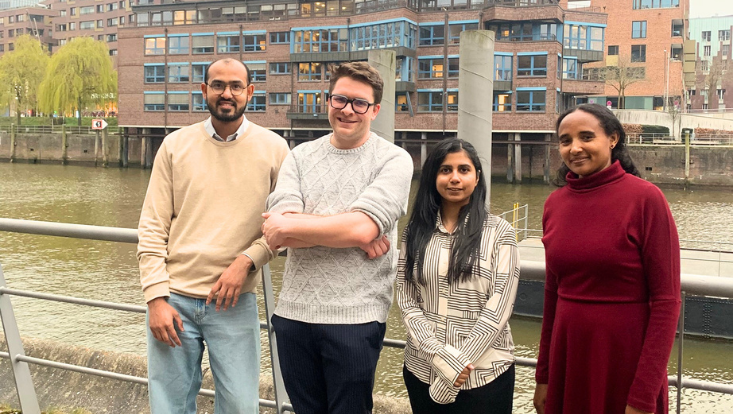
Foto: HRA
Internationalization is an essential part of the doctoral journey. It can shape research approaches, support personal growth, and open up future career paths. While international mobility is often the most visible aspect, internationalization encompasses many interconnected elements beyond just a change of location.
From 30 March to 2 April, the third edition of the EUGLOH program “Making an Impact! Skills for Career Paths in and beyond academia” took place in Hamburg.
Following the week’s activities, we spoke with four doctoral researchers from the University of Hamburg. In this interview, they share their reflections on the opportunities and challenges they experience while navigating their doctoral journey in an international context.
Doctoral researcher at the Institute for Systems Neuroscience, University Medical Center Hamburg-Eppendorf (UKE). He studies how our brain uses knowledge and attention to process and understand the visual world.
How would you describe the impact of the international environment in Hamburg on your research, personal development, and your future career prospects?
The international research environment has had a highly positive impact on my academic and personal growth. In research, colleagues from diverse educational and cultural backgrounds often bring unique ideas and problem-solving approaches. This diversity of expertise has broadened my view of scientific challenges and how to address them. Personally, it has made me more open-minded, tolerant, and appreciative of different viewpoints. Additionally, international mobility has helped me build a diverse professional network, which I believe is valuable for future collaborations, career opportunities, and continued growth as a researcher.
Nahid, you live in Hamburg with your family. Does being internationally mobile as a researcher sometimes create challenges in balancing personal life, research, and career opportunities?
International mobility as a researcher has been highly motivating for my academic and professional growth. It has provided opportunities to develop extensive research skills, experience different research settings, and advance academically. However, balancing international mobility with family life can also be challenging. As I live with my family, career decisions are shaped not only by professional opportunities but also by my family’s well-being. When considering advanced training or academic positions, I must carefully evaluate family stability and my child’s ability to adapt to new environments.
Doctoral researcher at the Cluster of Excellence “Understanding Written Artefacts”, University of Hamburg. His research focuses on a corpus of medicinal and esoteric Arabic-script manuscripts from 19th-Century West Africa, housed in the Wellcome Collection in London.
How would you describe the impact of the international environment in Hamburg on your research, personal development, and your future career prospects?
Coming from African studies, research in my field today is unimaginable without the high degree of internationalization that is its lived reality. On a more personal level, I feel like academia truly is one of the remaining beacons of international cooperation, and working in it does make me optimistic about the future, regardless of current events in the world. In this respect, the EUGLOH program was a brilliant opportunity to get to know other mindsets, academic cultures, and perspectives – and, as a linguist, I took immense joy from being able to speak all four languages I know almost every day of the week.
Jannis, the EUGLOH program in Hamburg was an experience of “internationalization at home” for you – what are the main takeaways you gained from it?
For me, this format of “internationalization at home” was perfect: In a bustling phase of my PhD, busy with the usual tasks when approaching the finish line, all the while looking for new job opportunities, I could not have participated in an event that entailed travelling abroad. One of the most eye-opening aspects for me was the reaction to a lot of international participants to Hamburg: Everyone I spoke with loved different things about the city, which in turn made me more aware of its advantages – cherishing what you have directly in front of you is often forgotten in daily routines!
Doctoral researcher in the BMFTR Junior Research Group Genomics of Retroviral Infections, Leibniz Institute of Virology (LIV). Her research focuses on investigating the immunomodulatory properties of Human Endogenous Retroviral (HERV) envelope proteins using quantitative proteomics to characterize their role in modulating host immune response.
How would you describe the impact of the international environment in Hamburg on your research, personal development, and your future career prospects?
Relocating to Hamburg for my PhD in a highly advanced research institute allowed me to benefit from working with experts within my field. This experience has enabled me to learn advanced scientific techniques, foster meaningful engagement with fellow researchers, and built professional network to further my career. Overall, the international experience boosted my confidence as a researcher while also improving my interpersonal skills.
Swaiba, what benefits do you gain from the highly international environment at LIV? Are there also challenges you face in your daily work and research?
Pursing my PhD at LIV in the field of infectious diseases has been an incredibly remarkable experience, contributing both to my academic and personal development so far. As an early-stage researcher, this setting has allowed me to improve my critical thinking and pushed me beyond my comfort zone, encouraging me to acquire new skills and apply them to address key scientific questions. While the highly international environment naturally comes with its challenges — such as adapting to a new culture and navigating language barriers — these have ultimately proven to be valuable learning opportunities.
Doctoral researcher at the Asia-Africa Institute, Hiob Ludolf Centre for Ethiopian and Eritrean Studies, University of Hamburg. Her PhD project, "Scribes and Practices of Manuscript Production in the Twenty-First Century Gondar Area, Ethiopia", focuses on reconstructing the professional histories of scribes and examining their manuscript-production practices in twenty-first-century Ethiopia.
How would you describe the impact of the international environment in Hamburg on your research, personal development, and your future career prospects?
My international mobility, for pursuing my PhD at the University of Hamburg and engaging with international research environments, has significantly shaped my academic and personal growth. It has broadened my research perspective by enabling cross-border collaboration and increasing the visibility of my PhD project. Additionally, working in diverse, multicultural teams has enhanced my intercultural communication skills, adaptability, and resilience. These experiences not only enhance the quality of my research but also strengthen my career prospects by equipping me with a global outlook, networks, and competencies essential for pursuing future academic or non-academic roles in an increasingly interconnected world.
Addisie, you're currently considering postdoctoral options. From your perspective as an advanced researcher, what role does internationalization play for academic career planning?
My stay plays a multifaceted role in my academic career planning, offering numerous benefits and opportunities. 1. Enhanced Research Opportunities: Engaging in international collaborations expands my research possibilities and facilities. 2. Career Advancement: Experience gained through my international mobility will be valued by hiring committees and funding bodies. 3. Skill Development: It develops my intercultural competence, language skills, and adaptability. 4. Academic Network Expansion: Building a global network of colleagues can lead to long-term collaborations and career opportunities across borders.

